BLOG
A Straight Line In One Step
There is great debate between what matters most: operating the horse's mind, or the horse's body. The interesting part is that proponents on either side tend to leave out vast amounts of a well interconnected system: the horse's mind, thoughts, and feelings of internal safety vastly affect the positioning of their body, their rigidity or suppleness, and their ability to be "on the aids" or resistant.
But the horse's body, like our bodies, requires physical conditioning in a logical and progressive manner to be able to achieve athletic feats. I can have my mind 100% on a handstand, but without the training that goes into it, it doesn't matter how much my mind is on this task and nothing else if my body cannot follow suit. In fact, I have been training toward a handstand for months, and find the process of balancing and strengthening my body toward this goal maddeningly slow - and if I do not take this process, guided by professionals who understand movement, biomechanics, anatomy and so on, I am very liable to injure myself.
Furthermore, a horse underconditioned or worried about their balance will become anxious, resistant, and more - their physical body being neglected leads to resistance of the mind.
Take the circle as a great truth teller:
If the horse's mind is worried, not thinking in the direction of travel, distracted by pain, discomfort, or outside influences of any kind, the rider's aids to bend the horse will not be successful.
If the horse's body is not prepared for the forces exerted on them by a circle: an outside stabilizing hind leg, an inside flexing hind leg bending deeper under the body, a rib cage that expands to the outside of the circle, an inside shoulder that lifts and swings forward, flexion at the poll, and an even bend through the entire spine, the horse will struggle - falling in, falling out, losing their tempo, hanging on the inside rein or leg, counterbending and so on, are all evidences or poor preparation for bending on a circle.
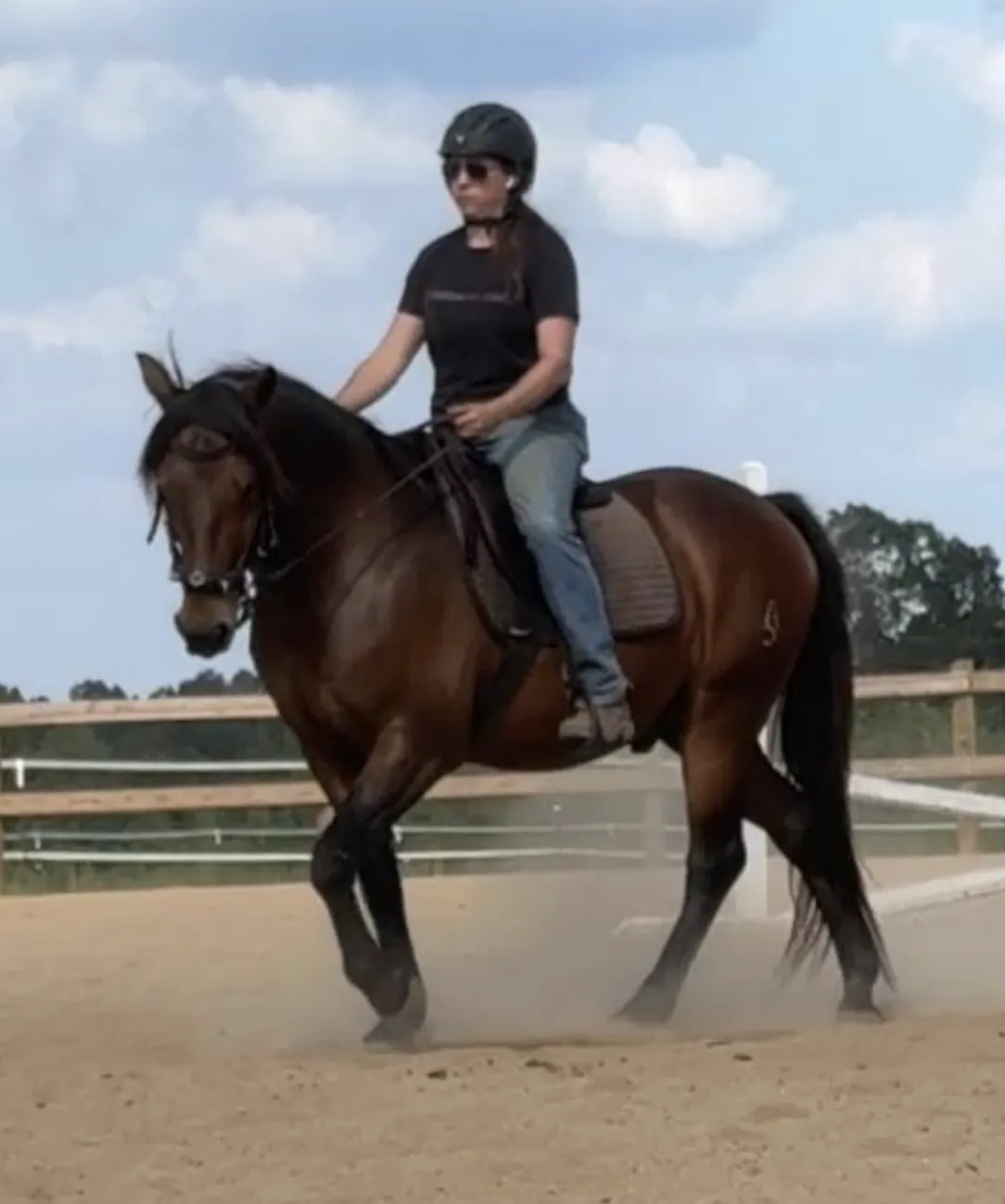
What is the best way to tell a horse is mentally and physically involved in the task of a circle (or any task)? You can leave it for a straight line in one step.
If the mind of the horse is "between the aids," there are hooked on to you and know where your thoughts will lead them next - and naturally, their thougths are there too - on this new line of travel
If the body of the horse is following the effects of balancing work: even weight and flexion toward both hind legs and lighter shoulders - leaving a movement to a new path of travel in one step is easy - like a tennis player ready to go in any direction, with a nice bend in the joints, they can move fluidly and without resistance in the new direction.
A mind directs the body - but the body should not be neglected in conditioning, preparing, and directing. It is one well interconnected system afterall.

GIVE YOU AND YOUR HORSE A PATH FOR DEVELOPING QUALITY HORSEMANSHIP.
© 2024 Amy Skinner Horsemanship. All Rights Reserved.