BLOG
Rider Straightness
Rider straightness...relative to what?
A lot of people think of rider alignment in terms of just the rider - Ear-shoulder-hip-heel. The theory is the rider should stand as if they were on their own feet, without the horse. If the heel is too far forward or back, the rider would topple backward or forward. This is true, and a great concept.
But it becomes much more complex when we add in the horse. Why? Because the horse is not a straight surface, like the ground we might be practicing on. The horse often carries his own crookednesses - and may be crooked in one way at rest, and crooked in many different ways in movement, changing from gait to gait and direction to direction.
To have good alignment in movement, a rider now needs to take in a complex and ever changing set of sensory information through their seat to adjust this alignment. It's a bit like what I imagine surfing to be: You are constantly adjusting your lower half to a rise and fall and adjusting your center of gravity to stay somewhere in the center of yourself. (surfers, correct me if I'm wrong).
To be an aligned rider, you need to be able to be straight relative to a crooked horse in motion. This means the horse will move you from one side to another, and you need to be able to siphon some weight out of the heavy side and put it back over to the empty side - so you FEEL equal on both sides. This is very different than simply sitting straight.
A good rider needs to be able to not just take both reins equally, but out equal FEELING into both reins. This means they are adjusting the horse to move equally underneath them, funneling this into both reins equally.
When we teach and interpret information in two dimensions, we end up with flat, unfeeling riding. A horse in motion changes constantly, and so does a rider.
And so good riding is really the art of taking in sensory input constantly and sorting it into an organization, like conducting an orchestra: each piece of the band plays their role within a larger structure.
A rider takes into account their own body balance in motion, the horse's balance in motion, and works to put the two centers of gravity closer together. This is when you can actually use your body to straighten the horse, instead of just being a victim to the horse's imbalance - following their crookedness while fighting them with the rein and leg aids.
Ideally, you position your weight to bring the horse to your center, and rein and legs support as needed.
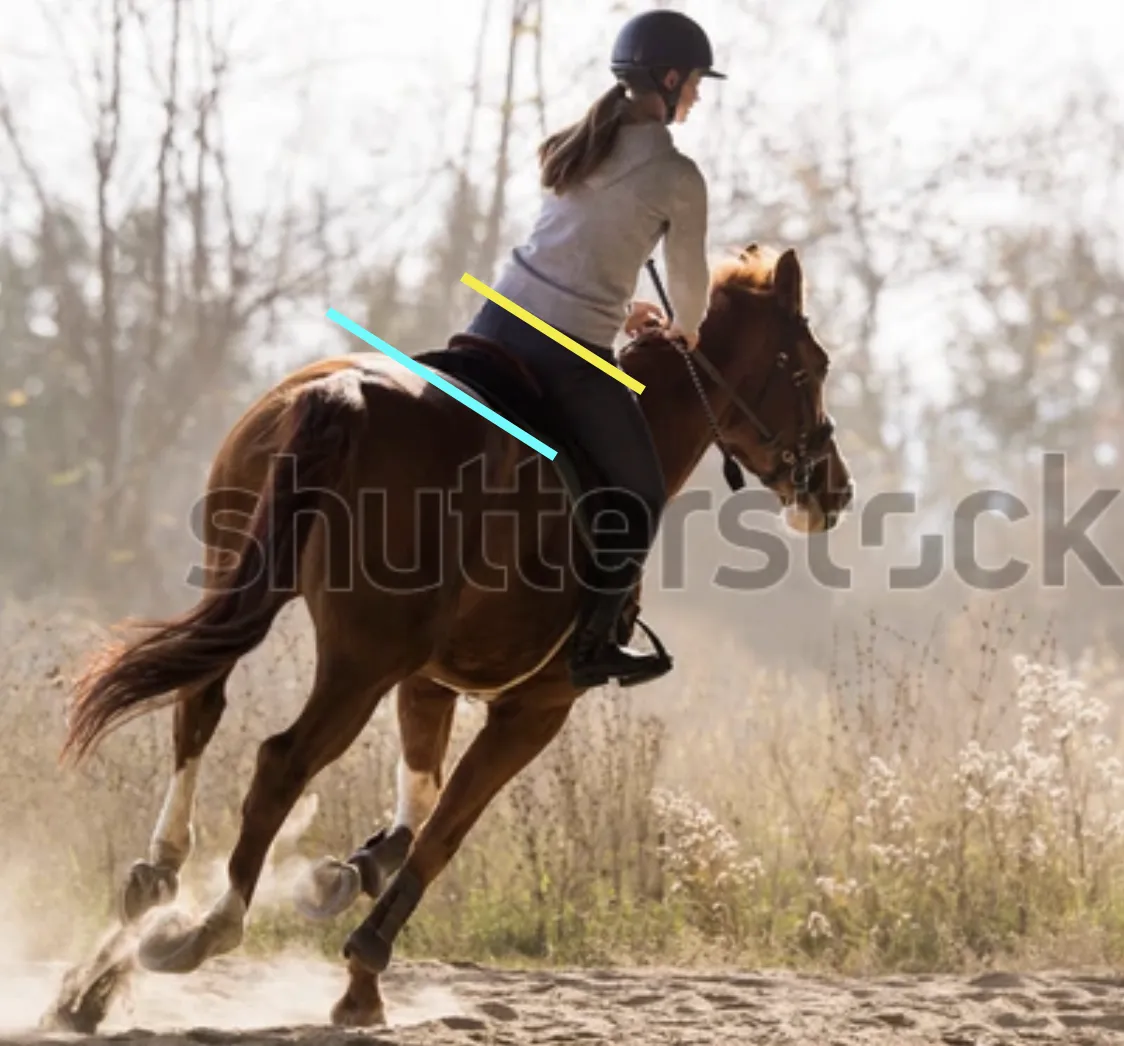
People always get mad at me when I draw lines on pictures, but here is a stock image with some lines on it to illustrate the point - two bodies in motion, crooked together: a rider following a horse's crookedness. Being straight only helps on a perfectly level surface, and this is not the case here -
This is a hefty topic which is a lot to put into one article. But I try to teach it in every lesson, in every riding course I do (especially in Riding in Rhythm 1 and 1.5), and every clinic there is some discussion of this if we're riding. You could spend a lifetime getting good at this! But it makes the world of difference to a horse to be able to support them truly with your body instead of just squeezing and pulling legs and reins trying to manage a crooked body when your body is not in a position to support.

GIVE YOU AND YOUR HORSE A PATH FOR DEVELOPING QUALITY HORSEMANSHIP.
© 2024 Amy Skinner Horsemanship. All Rights Reserved.